The Kings of Israel and Judah |
The Kings of Israel and Judah
*(Note: The kingdom of Israel divided
into two parts, the northern kingdom (Israel/Ephraim) represented in red, and the southern kingdom
(Judah/Jews), represented in blue.)
*(Note: The kingdom of Israel divided into two parts, the northern kingdom (Israel/Ephraim) represented in red, and the southern kingdom (Judah/Jews), represented in blue.)
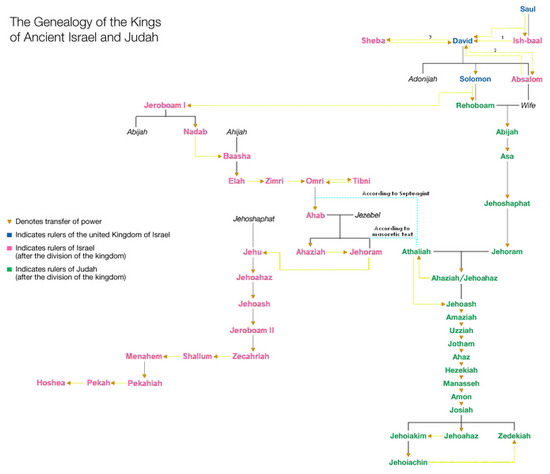 Source of Table: http://commons.wikimedia.org/wiki/File:Genealogy _of_the_kings_of_Israel_and_Judah.png |
Slightly Adapted from:
Contents:
1. Kings of United Israel
2. Kings of Judah (Rehoboam, Abiyah, Asa)
3. Kings of Israel (the Ten Tribes): Jeroboam, Nadab, Baasha, Ealah, Zimri
4. Kings of Judah (Jehoshaphat, Joram, Queen Athalia, Ahaziah)
5. Kings of Israel (the Ten Tribes): Omri, Ahab, Ahaziah, Jehoram, Jehu
6.Kings of Judah: Queen Athalia, Joash, Amaziah
7. Kings of Israel (the Ten Tribes): Jehu, Joash, Jehoash, Jeroboam-2
8. Kings of Judah: Uzziah (Azariah), Jotham, Ahaz. [During their reign the rulers of northern Israel were Jeroboam-2, Zechariah, Shalum, Menahem, Pekahiah, and Pekah].
9. Kings of Israel (the Ten Tribes): Jeroboam-2, Zechariah, Shallum, Menachem, Pekahiah, Pekah, Hosea
10. Kings of Judah: Hezekiah, Manasseh, Amon, Josiah, Jehoahaz, Jehoiakim, Jeconiah, Zedekiah
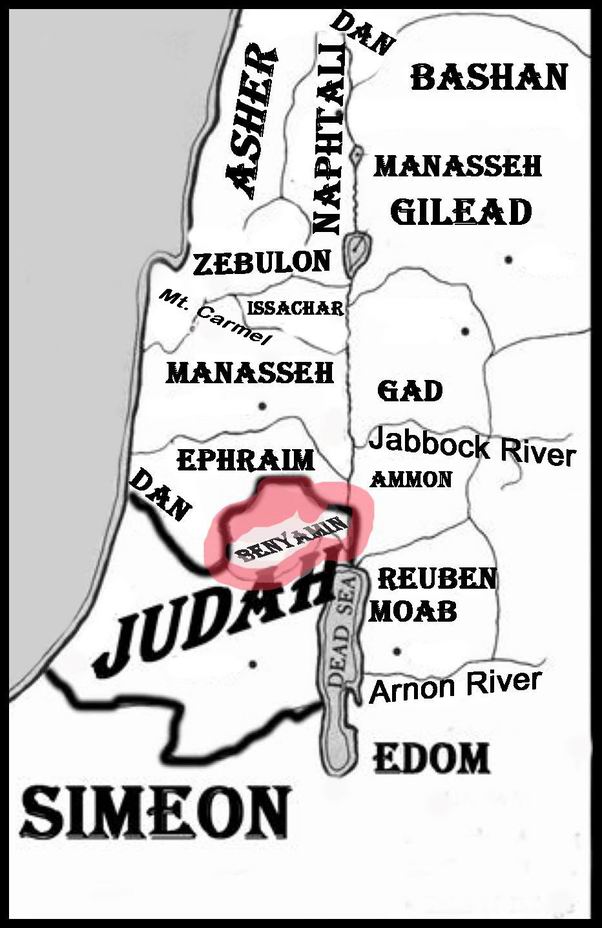
The first King of Israel was Saul from the Tribe of Benjamin.
Ish-Boshet the son of Saul reigned over the northern Ten Tribes for about 2 years.
David the son of Jesse from the Tribe of Judah reigned first over Judah from Hebron then over all Israel from Jerusalem.
2. Kings of Judah (Rehoboam, Abiyah, Asa)
Rehoboam was the son of Solomon. His mother was Naamah from Ammon. King David had been descended from Ruth the Moabitess.
Intermarriage with females (who converted) from Moab and Ammon was permitted but with males it was prohibited (Numbers 8:1-3, Deuteronomy 23:4). This is proof of the Oral Tradition. Non-Jews have trouble accepting this.
In the reign of Rehoboam the Ten Northern Tribes seceded, Shishak of Egypt invaded both Judah and the northern Kingdom.
Abiajah (Abijam) of Judah defeated Jeroboam of Israel in battle.
Asa defeated Zerach of Cush.
Asa also went to war against King Baasha of northern Israel. Baasha had been allied with Aram (Syria). King Asa persuaded Aram to change sides and attack Baasha.
3. Kings of Israel (the Ten Tribes): Jeroboam, Nadab, Baasha, Ealah, Zimri
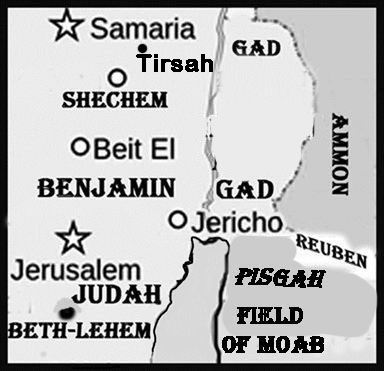
Jeroboam, son of Nebat, was of the Tribe of Ephraim. He set up two golden calves; one in Bethel and the other in Dan. He demoted the Levites (1-Kings 12:31) who subsequently moved en masse to Judah (2-Chronicles 11:13-14, 13:9).
The first center of Jeroboam was the city of Schechem ("Nablus"). Later the capital was moved to Tirsah north of Schechem.
Nadab the son of Jeroboam was assassinated. He was replaced by one of his generals, Baasha.
Baasha came from the Tribe of Issachar. He fought against Asa of Judah and Ben-Hadad of Aram. ["Ben-Hadad" appears to have been the name of all members of one particular dynasty that ruled over Aram i.e. Syria and the north].
Ealah, son of Baasha, fought the Philistines. He was killed by Zimri who attempted to take control in his stead.
Zimri was killed and replaced by Omri.
^^^^^^^^^^^^^^
4. Kings of Judah (Jehoshaphat, Joram, Queen Athalia, Ahaziah)
Jehoshophat, the son of Asa, married the daughter of Omri of Israel. Jehoshaphat was therefore brother-in-law to King Ahab son of Omri (since Jehoshaphat had married the sister of Ahab). Jehoshaphat joined Ahab in a war against Syria. Later, together with Ahaziah (the son of Ahab) Jehoshaphat built a fleet in Ezion Geber (ca. Elath) to sail to Tarshish (Spain, Gaul, and Britain) on the Atlantic Ocean. The fleet however was destroyed by a storm. Jehoshaphat subdued the Edomites, Philistines, and Arabs. Jehoshophat of Judah together with Joram (son of Ahaziah son of Ahab) of Israel and the King of Edom invaded Moab but they were forced to retreat. After that, Judah under Jehoshophat was attacked by a combination of Edomites, Moabites, Ammonites, Philistines, etc. All of these combined antagonistic forces, by miraculous intervention, quarreled among themselves and massacred each other.
Joram, son of Jehoshophat was ruled by his wife, Athaliah, who was the daughter of Ahab of Israel. The mother of Athalia was Jezebel from Sidon. The Philistines and Arabs attacked Jerusalem.
Ahaziah son of Joram was dominated by his mother Athaliah. King Ahaziah joined King Jehoram of Israel in attacking Syria. Both Ahaziah and Jehoram were killed in the Land of Northern Israel by Jehu in a coup. Note that the ruling houses tended to intermarry with each other and also had similar names to each other (cf. Jehoram, Joram, Ahaziah of Judah and Ahaziah of Israel, etc). This can be confusing.
^^^^^^^^^^^^^^
5. Kings of Israel (the Ten Tribes): Omri, Ahab, Ahaziah, Jehoram, Jehu
Omri spent the first 5 years of his reign in conflict with Tibni of Ginath who also claimed the throne. Omri built the city of Samaria ("Shomron" in Hebrew). [Samaria was also the name applied to the whole province around the city and in Prophecy the term is frequently used to represent the whole northern ten-tribed kingdom of "Israel"]. The daughter of Omri married Jehoshophat, the son of Asa of Judah.
Omri lost the city of Ramoth Gilead and its territory in the north to Syria. He defeated Moab and the Philistines.
Ahab, the son of Omri (brother-in-law of Jehoshaphat of Judah) married Jezebel daughter of the King of Sidon, the leading Phoenician city at that time.
King Ahab and Queen Jezebel promoted the pagan Canaanite cult of Baal and Astarte (Asherah). The prophets Elijah and Elisha were active at this time. Ahab married his daughter, Athaliah, to his nephew Joram of Judah, the son of King Jehoshophat by the sister of Ahab. Ahab and Jehoshaphat went against Syria, and Ahab was killed.
Ahaziah, the son of Ahab, lost control of Moab. He died falling out of a window.
Jehoram (Joram) succeeded his brother Ahaziah. Jehoram of Israel together with Jehoshophat of Judah, and the King of Edom campaigned against Moab. They were forced to retreat. Jehoram of Israel and Ahaziah (the son of Jehoshophat) of Judah campaigned against Syria over Ramath Gilead. One of the military commanders of Israel named Jehu, led a revolt and killed both Jehoram of Israel and Ahaziah of Judah.
Jehu then was declared king over Israel. Jehu also killed Jezebel the mother of Jehoram.
^^^^^^^^^^^^^^
6. Kings of Judah: Queen Athalia, Joash, Amaziah
When her son King Ahaziah was killed by Omri together with Jehoram of Israel, Athalia took over in Judah. She killed all members of the House of David (including her own grandchildren) except Joash who was hidden and escaped. Athaliah reigned for six years and was later killed by order of the High Priest, Jehoiada, who became regent during the infancy of Joash.
In the reign of Joash Judah was raided by Hazael King of Syria. Joash repaired the Temple but later turned to idol worship and slew the Prophet Zechariah.
Amaziah (son of Joash) was the brother of Amoz who was the father of Isaiah the Prophet. Amaziah defeated Edom and attacked Joash of Israel but he was defeated. He was dethroned by a coup and fled to Lachish in the southwest where he held out for 15 years. During this time his son, Uzziah (also known as Azariah), ruled over the rest of Judah.
^^^^^^^^^^^^^^
7. Kings of Israel (the Ten Tribes): Jehu, Joash, Jehoash, Jeroboam-2
Jehu lost control of the territories east of the Jordan, i.e. the lands of Reuben, Gad, and the half-tribe of Menasseh. They were conquered by Hazael, King of Aram and later by the Assyrians. Archaeological evidence indicates that the Israelites in these regions were heavily influenced by Aramaic culture and language.
During the reign of Joash (son of Jehu) Northern Israel was oppressed by Aram (Syria) but it was saved by his son Jehoash.
Jehoash defeated Amaziah of Judah who had attacked him.
Jeroboam-2 conquered Moab and Syria. He co-operated with Judah and gave northern Syria and southeast Turkey over to Judaean control. In this region a colony of Judaeans (known as “Yadi”) was established or had been set up previously and was re-consolidated. They adjoined a northern settlement from the Tribe of Dan.
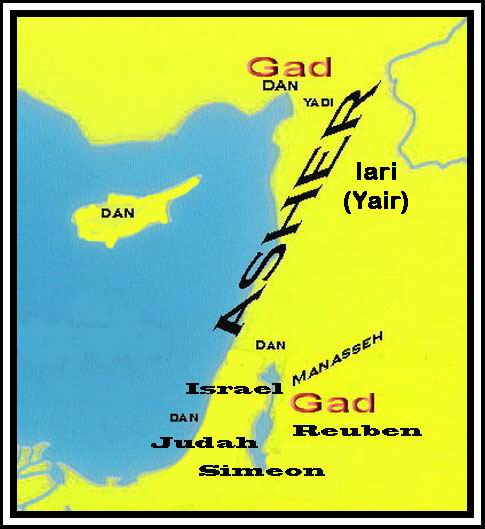
Jeroboam-2 co-operated with the Phoenicians who consisted of Canaanites, Israelites, and others.
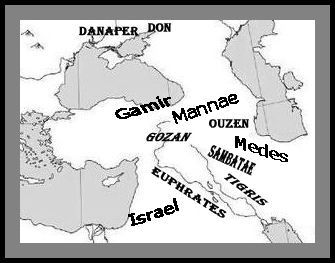
Places of Exile of the Ten Tribes.
^^^^^^^^^^^^^^
8. Kings of Judah: Uzziah (Azariah), Jotham, Ahaz. [During their reign the rulers of northern Israel were Jeroboam-2, Zechariah, Shalum, Menahem, Pekahiah, and Pekah].
Uzziah (Azariah) of Judah co-operated with Jeroboam-2 of Israel. Jeroboam gave Uzziah control of Cilicia in southeast Turkey where a colony of Judaeans was established alongside a colony of Dan. Dan and Judah were frequently together. Later in Denmark the Danes (from Dan) were accompanied by Jutes from Judah. King Uzziah in Judah strengthened the fortifications. He developed and produced war-machines and military equipment. Uzziah defeated the Philistines and Arabs. He encouraged agriculture and industry, irrigation works, and exports to Arabia and India. He increased gold and silver. In the latter years of his reign he was stricken with leprosy and was considered as one "dead" while his son reigned in his stead.
After Uzziah, Jotham of Judah built forts, and strengthened defenses. He subdued the Ammonites.
Ahaz of Judah worshiped Moloch. Practices associated with Moloch such as jumping over fires etc. at the "Beltane" festival were practiced until recently in northern England, Scotland, and Sweden.
The Edomites revolted against Ahaz and took captives from Judah. The Philistines also conquered territories from Judah. Pekah of Israel and Rezin of Syria attacked Judah. Many Jews were taken captive into Damascus. Damascus of the Bible was on the Euphrates and was not identical with Damascus of today which is further south. The captives of Judah that were taken to Damascus apparently eventually merged with exiles from the Northern Kingdom. The Assyrians (under Sennacherib) were also later to attack Judah and take captives. One way and another a good portion of Judah actually went into Exile with the Ten Tribes and were mixed with them. Even so, "Judah" in Biblical terms refers to those Jews who remained and kept their religion and whose identity is known. Those whose identity is unknown are counted together with the northern Israelites who are referred to separately. The future Messiah is to come from Judah meaning from among the present-day Jewish people.
Pekah of Israel slew 120,000 men in Judah and also took many captives which were later released. Rezin of Syria took Elath (in the extreme southeast, on the Gulf of Akaba) from Judah, expelled the inhabitants and replaced them with Edomites. The Edomites also attacked Judah and took captives.
Ahaz was followed by Hezekiah as King of Judah.
^^^^^^^^^^^^^
9. Kings of Israel (the Ten Tribes): Jeroboam-2, Zechariah, Shallum, Menachem, Pekahiah, Pekah, Hosea
In Israel Jeroboam-2 was followed by his son Zechariah who ruled in Samaria for six months before being assassinated and replaced by Shallum who reigned for a month.
Shallum was killed by Menachem who ruled for 10 years.
Menachem paid tribute to Assyria.
Menachem was followed by his son Pekahiah who ruled for two years. Pekahiah was killed by Pekah the son of Remalia.
In the days of Pekah Tiglathpileser exiled all the northern area of the kingdom of Israel: Ijon, Abel-beth-Maachah, Janoah, Kedesh, Hazor, Gilead, Galilee, Naphtali.
This was the overwhelming bulk of the northern kingdom.
Pekah was followed by Hosea who was the last king of Israel.
At this stage only an area around the city of Samaria remained of the Northern Kingdom. After a siege of three years Samaria was taken by the Assyrians and all its inhabitants exiled. The Kings of Assyria later settled pagans in the region of Samaria who became known as "Samaritans." The Samaritans adopted aspects of the Hebrew religion and absorbed a few remnants of those who remained of the Northern Israelites. The Ten Tribes themselves NEVER returned. They became the Lost Ten Tribes of Israel.
^^^^^^^^^^^^^^
10. Kings of Judah: Hezekiah, Manasseh, Amon, Josiah, Jehoahaz, Jehoiakim, Jeconiah, Zedekiah
Hezekiah purified the Temple at Jerusalem in the first year of his reign and in the sixth year the Northern Kingdom was exiled. In the 14th year of Hezekiah the Assyrian King Sennacherib captured all the unwalled cities of Judah and exiled their inhabitants. Assyrian inscriptions tells us that more than 200,000 citizens of Judah were taken into Exile where (according to Midrashim) they joined their brothers from the Ten Tribes. Sennacherib besieged Jerusalem but was temporarily diverted by an invasion of Tirhaka of Cush (translated as "Ethiopia"). Sennacherib later returned to besiege Jerusalem but 185,000 of his warriors were smitten dead by an angel of God. Sennacherib returned to Nineveh where he was assassinated by his sons who then fled to Ararat (translated as "Armenia"). In the reign of Hezekiah the exile of the Northern Tribes was completed. They were all taken away by Assyria, Nevertheless refugees and others from the Ten Tribes did escape and came to Judah in the time of Hezekiah. Israelites from the Tribes of Ephraim and Manasseh, Asher, and Zebulun are mentioned in Scripture as coming to Jerusalem and in some cases evidently remaining there. Hezekiah built the Siloam Tunnel to supply Jerusalem with water from an underground source outside of the walls of Jerusalem. This may still be seen.
After Hezekiah, his son Manasseh reigned. King Manasseh was subject to Assyria. Manasseh persecuted the prophets. He worshiped idols and put Isaiah to death. The King of Assyria took Manasseh captive to Nineveh. Manasseh repented and was restored to the throne of Judah.
Amon followed Manasseh. He practiced idolatry. He servants assassinated him and his son Josiah became king.
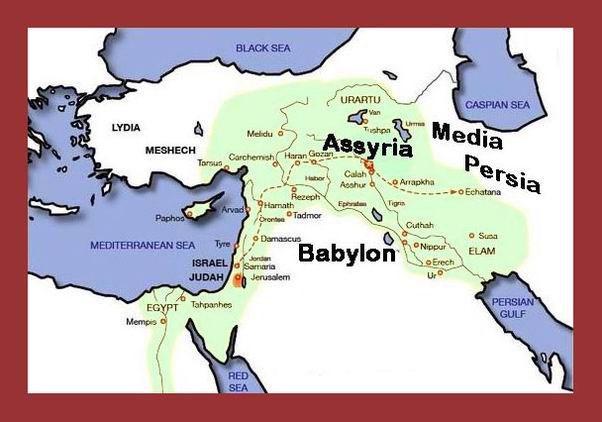
Josiah son of Amon reformed Judah. Josiah purified the Temple. He extirpated idolatry and pagan shrines from Judah and also throughout much of the former northern domain of Israel. Josiah asserted his independence from Assyria. Meanwhile the Exiled Israelites from the Ten Tribes had also become independent and federated with the Cimmerians, Scythians, and Guti (Goths). In the time of Josiah the Israelite-Scythians took over the Assyrian Empire for a brief period. Josiah made contact with them. The prophet Jeremiah was instrumental in this. An attempt was made to re-settle the Exiled Israelites in their norther areas. Beth-Shean (in the former Tribal area of Manasseh) became the Scythian capital from which they began to rule over the Middle East. The Scythians however lost control of the Assyrian Empire. Their attempts at re-settlement in the areas of Northern Israel were abandoned and they returned to their places of Exile in the north. A portion of the Scythians found themselves in an alliance with a revived Assyria against the Medes and Babylonians. Shortly after the Scythians changed sides and played a major role in the destruction of Assyria. After the defeat of Assyria, the Medes betrayed their Scythian allies. They ambushed and massacred the Scythian leadership. Medes and Babylonians divided the former Assyrian Empire between them. They progressively drove the Scythians out of the Middle East and into southern Russia. From there the Scythians moved westward. King Josiah of Judah was killed at Megido fighting against the Egyptians. The Egyptians were attempting to move northward and help the Assyrians against their Babylonian adversaries.
Josiah had four sons: Johanan, and Eliakim, Mattanyahu, and Shallum.
When Josiah died his youngest son Shallum became king of Judah, under the name “Jehoahaz.” After him Eliakim became King and changed his name to “Jehoiakim.” He was followed by his son Jeconiah; Jeconiah was succeeded to the throne by his uncle Mattanyahu, under the name “Zedekiah.”
After that all the Jews of Judah were exiled by Babylon. This was the beginning of the Jewish Diaspora. The Persians had been subjects and tributaries to the Medes. They took over from them and then conquered Babylon. Cyrus the King of Persia allowed the Jews to return to Judah seventy years after they had been exiled.
Click Here

Pleased with what you read?
Click Here to make an offering. |
'It is impossible to rightly govern the world without God or the Bible.'
George Washington
Brit-Am is the "still small voice" that contains the truth.
[1-Kings 19:12] AND AFTER THE EARTHQUAKE A FIRE; BUT THE LORD WAS NOT IN THE FIRE: AND AFTER THE FIRE A STILL SMALL VOICE.
Brit-Am Home
|
Brit-Am Discussion Group 
|
Contents by Subject |
Research Recognition Reconciliation Contribute |

|
Site Map Contents in Alphabetical Order |
 This Site |